
James Hardie ADU Builders in Murrieta: A Homeowner’s Guide
If you’re building an ADU in Murrieta, the siding question usually gets settled before the foundation is even poured, and the answer increasingly comes down to one material: James Hardie fiber cement. It resists fire, shrugs off the Temecula Valley UV load, and won’t warp when a Santa Ana wind event pushes 50 mph gusts through French Valley. That combination matters more in Murrieta than in most Southern California cities, because a meaningful slice of our residential lots sit close enough to Riverside County Fire Hazard Severity Zone boundaries that siding choice can trigger an additional compliance review during plan check. Choose wrong, and your permit stalls for two to four weeks. Choose Hardie, and the plan reviewer usually keeps moving. If you’d rather not sort through the material specs yourself, call (866) 808-7312 and we’ll walk you through what applies to your specific lot.
Why Murrieta’s Fire Zones Make James Hardie a Permit Strategy, Not Just a Style Choice
Murrieta sits in a geographic pocket where suburban subdivision streets taper into dry brush canyons. Neighborhoods like Copper Canyon, parts of Bear Creek, and the hillside lots off Clinton Keith Road all sit near mapped Wildland-Urban Interface boundaries. When your ADU falls inside or adjacent to a Fire Hazard Severity Zone buffer, Riverside County plan check will ask for ignition-resistant construction details on the exterior. That means non-combustible or ignition-resistant siding, ember-resistant venting, and sometimes a Class A roof assembly on the accessory unit.
James Hardie fiber cement carries a non-combustible rating that satisfies the siding portion of that review without a fight. Vinyl siding does not. Stucco does, but stucco brings its own cost and cracking profile in Murrieta’s soil conditions, which we’ll get to. What surprises most homeowners is that this compliance benefit applies even when the primary home on the same lot still wears vinyl or wood lap siding. Grandfathering applies to the original structure, but a new detached ADU is new construction. It gets scrutinized under current code. That distinction trips up a lot of first-time ADU owners.
What we tell homeowners during initial site walks is simple: if you can see chaparral from your back fence, assume the fire review will touch your ADU, and pick your siding accordingly. James Hardie won’t guarantee a smooth plan check, but it removes the most common material objection we see flagged in this part of Riverside County.
What James Hardie Actually Does in Murrieta’s Climate: A Material Comparison
Murrieta is not coastal California. We get 95-degree summer days, single-digit humidity during fall wind events, nighttime temperature drops of 30 degrees or more, and an unrelenting inland UV index. That specific climate punishes exterior materials differently than it would in, say, Carlsbad or Irvine.
Here’s how the three most common ADU siding choices perform in Murrieta specifically:
James Hardie Fiber Cement
- Dimensional stability during 30-degree overnight temperature swings holds up better than vinyl, which expands and contracts enough to pop trim joints over a decade.
- The baked-on ColorPlus finish resists UV fading longer than standard paint on stucco, which chalks and dulls noticeably inland.
- Fiber cement does not off-gas or soften in high heat. When we install it on south-facing ADU walls in Murrieta’s summer, the board temperature can hit 140 degrees without any material compromise.
- Fire rating: non-combustible. This is the big one for plan check.
Stucco
- Fire-rated and common on older Murrieta homes, but prone to hairline cracking where expansive clay soil shifts under the ADU’s foundation.
- Small cracks that don’t bother anyone cosmetically become water intrusion points during the winter rainy season.
- Re-coating costs in Murrieta run $3.50 to $6.00 per square foot, and you’ll need it every 8 to 12 years if you want the house to keep looking current.
Vinyl
- Cheapest upfront by roughly 20 to 30 percent.
- Slow to degrade, but never truly fire-rated. In a fire-review zone, vinyl can force you into a boxed-eave or fire-sprinkler conversation that adds cost.
- We see vinyl look visibly tired after about seven or eight years of Murrieta sun. The color goes chalky, and no amount of power washing brings it back.
If the ADU is a rental, durability isn’t abstract. Every repaint or repair is a vacancy call or an owner weekend you don’t get back. Hardie’s roughly 15-year finish warranty on ColorPlus products, when installed to spec, is the reason it pencils out as the lower-maintenance choice for most Murrieta lots.
The Warranty Details That Actually Get Homeowners in Trouble
James Hardie’s warranty is specific, and we see homeowners lose fights with it for reasons that sound avoidable but happen constantly. The warranty covers the board itself and, on ColorPlus products, the finish. But James Hardie’s documentation names very precise installation details, and if the installer skips them, a future claim becomes a denial letter.
Here’s what to confirm with your builder before they start hanging Hardie on your Murrieta ADU:
- Clearance above grade and hardscape. Hardie requires a minimum gap, typically 2 inches above flatwork and 6 inches above dirt or a 1-inch gap above a gutter or roof line below. If your ADU slab sits tight to a walkway, the installer must hold that line or the warranty dies.
- Joint flashing behind butt joints. This is the most common skipped step in Murrieta ADU builds. Missing flashing lets water ride the seam into the wall cavity. Hardie will reject a claim for board or finish damage stemming from unflashed joints.
- Nailing pattern and fasteners. Nails must penetrate into framing or solid sheathing, not just the OSB skin, and heads need to be driven flush but not countersunk too deep. Overdriven nails compromise the board’s grip in high winds, which matters when Santa Anas blow through.
- Paint finish on field-primed edges. If cut edges aren’t sealed or the board isn’t paint factory-finished, edge wicking turns a 50-year board into a 15-year problem. In Murrieta’s wet winters, this shows up as swelling at the bottom edge first.
We pulled a board off an ADU over in Central Murrieta last spring where the previous installer had skipped the joint flashing on the windward wall. The homeowner was on his second repaint in four years and couldn’t figure out why the paint kept peeling. The wall cavity behind the seams was holding moisture. The fix was a full strip-and-reside of one elevation, not a repaint. That’s a $7,000 lesson that a 30-cent piece of flashing would have prevented. The warranty wasn’t going to help because the installation didn’t follow the published spec.
Cottage ADU Builders installs James Hardie to the letter of the published installation manual, including flashings and clearances, because warranty-backed siding only protects you if the installation matches what the manufacturer wrote down.
Matching Your ADU’s Siding to an Older Murrieta Primary Home
Most Murrieta neighborhoods built in the 1990s and early 2000s used a predictable mix: beige or gray stucco, some board-and-batten at gable ends, and ranch-style trims. When you add a detached ADU, the city’s design review in some planned communities will ask that the new unit be “compatible in style and material” with the primary residence. That’s a soft requirement, but it gets enforced when the ADU is visible from the street.
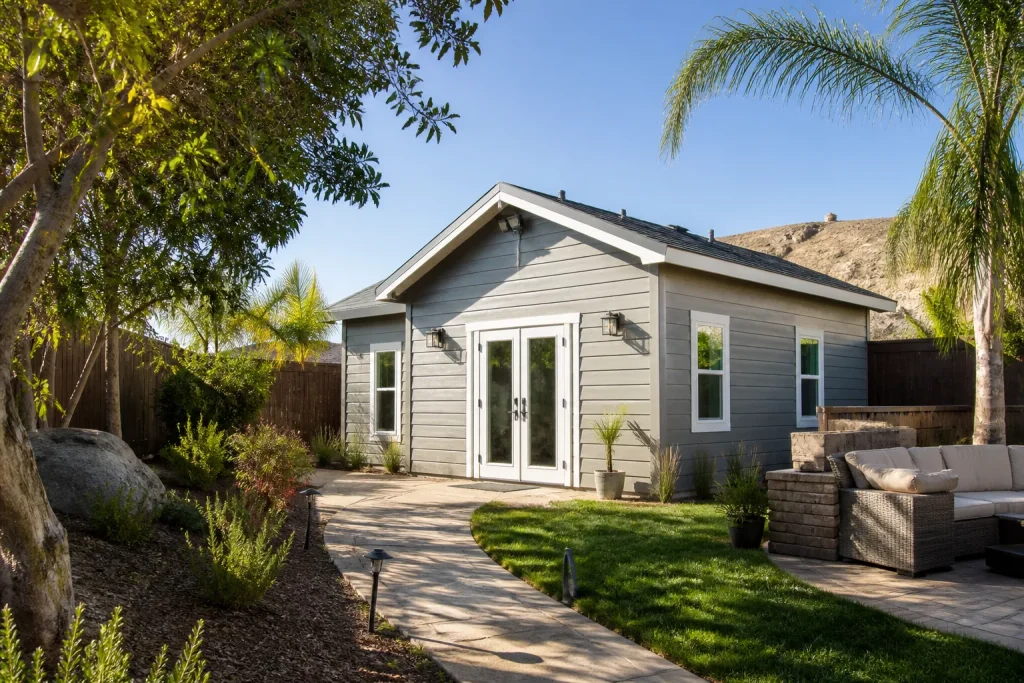
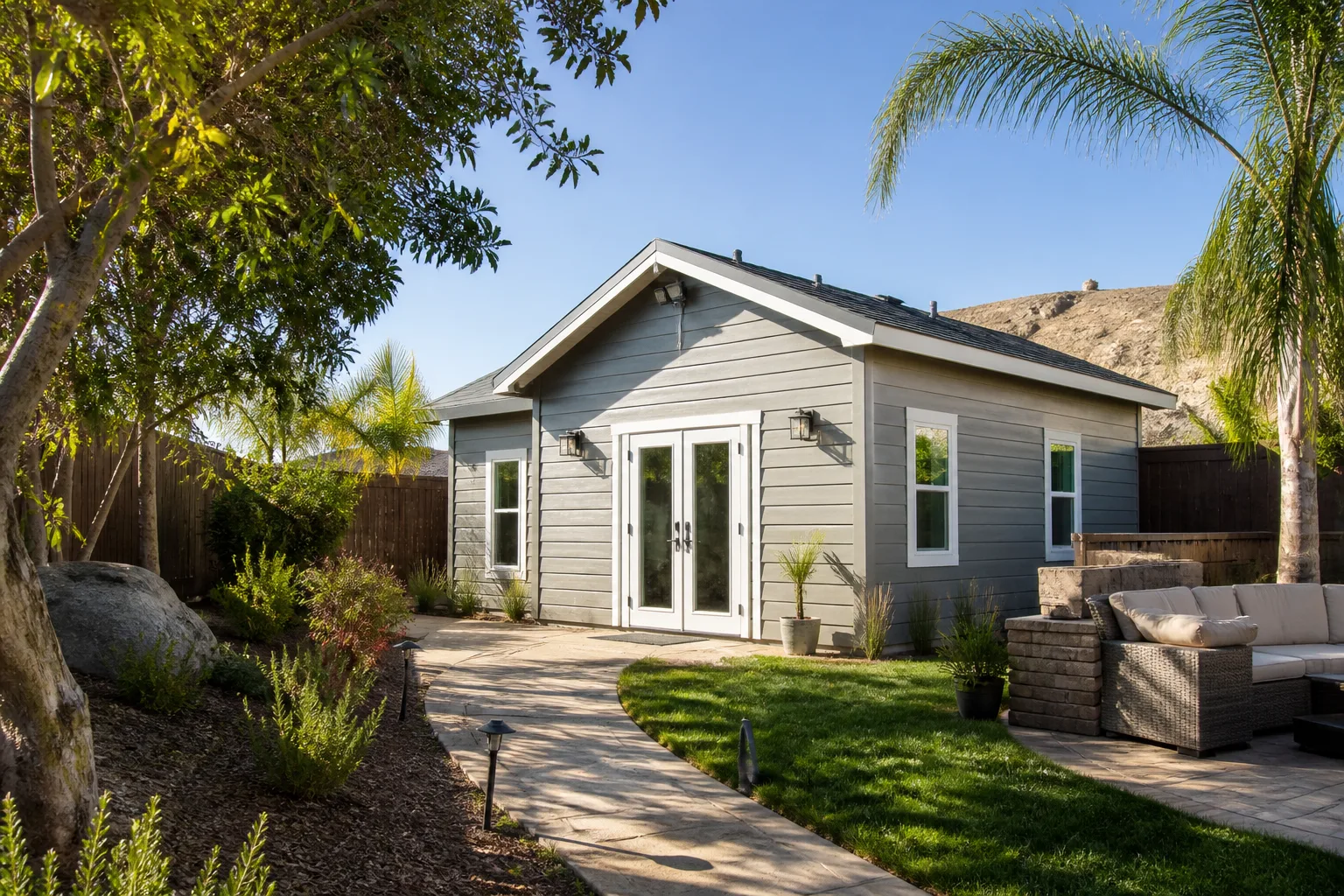
James Hardie gives you profiles that read as wood but don’t fight the existing home’s language. HardiePlank lap siding in a 6- or 7-inch exposure matches the look of a classic California ranch if the primary house has horizontal lines. HardiePanel vertical or stucco-profile sheets read closer to the original Murrieta stucco-and-board look without the maintenance cycle.
What we recommend most often: if the primary house is stucco, run HardiePanel smooth or Santa Fe finish on the ADU’s street-facing elevation and paint both structures in the same color family. If the primary house has wood lap at porch and gable areas, use HardiePlank select cedarmill texture on those same ADU zones. The ADU reads as an intentional companion building rather than a dropped-in box that doesn’t belong to the lot.
Paint matters as much as profile. We’ve had good results pulling the existing home’s body color and taking it one or two shades lighter on the ADU for a subtle contrast that design review reads as compatible. The goal isn’t camouflage. It’s making the ADU look like it was designed with the main house in mind, not dropped from a truck.
What a Hardie Exterior Adds to ADU Value in the Murrieta Market
Appraisers in the Temecula Valley market adjust for building materials when pulling comps on properties with ADUs. A vinyl-sided ADU is going to be compared against the bottom tier of local comps. A fiber-cement ADU that matches the main house tends to pull comps from the middle of the range, which is usually $20,000 to $40,000 in appraised value above the vinyl version on the same floor plan.
The math on cost is what makes it interesting. Upgrading a typical 600-square-foot detached ADU from vinyl to James Hardie in Murrieta runs about $4,500 to $7,000 at current labor and material pricing. Some of that is offset immediately by insurance: several carriers we’ve seen quote preferred rates for accessory units with non-combustible siding in this part of Riverside County, particularly for the fire-susceptible lots near the Santa Rosa Plateau and the hills above Murrieta Hot Springs Road. Over a 10-year hold, the insurance savings plus zero maintenance repaint costs plus a higher appraisal at refinance make the Hardie upgrade a net-positive financial line item, not an emotional splurge.
The framing here is straightforward: this is Murrieta, not a coastal zip code. Fire review is a real step in your permit process, and when the material that gets you through that review also holds value and skips maintenance across decades, the decision stops being a debate.
For modular and prefab ADU systems in particular, some brand designs already assume fiber-cement or composite cladding. We work with several of the factory-built options homeowners have heard of, including Cover, Dvele, and Boxabl, and the exterior finish conversation is one of the first things we settle, because the factory schedule depends on it. A modular unit that ships from the factory with vinyl or composite off-gassing issues isn’t a unit you want sitting in plan check in a Murrieta fire buffer zone.
When to Call a Pro
Installing fiber-cement siding is not a safe weekend project. Hardie board weighs about 2.3 pounds per square foot, which means a single 12-foot HardiePlank lap board runs close to 30 pounds, and you’re handling it on a wall, often above your head. That’s shoulder and back injury territory for someone who doesn’t do it daily. Cutting fiber cement also produces silica dust. James Hardie’s own safety instructions call for a specific dust-reduction method, typically a shearing tool or a saw with a vacuum shroud. Cutting it dry with a standard circular saw puts silica in the air around you and doesn’t meet OSHA’s respiratory guidance for the material.
We’re not going to tell you to grab a bundle of Hardie and start hanging it on your ADU. The material has a real learning curve, the warranty is unforgiving on installation details, and the dust isn’t worth the savings. If you’re considering it anyway, at least read James Hardie’s published installation requirements start to finish and rent the proper cutting equipment. Most Murrieta homeowners we talk to decide the savings isn’t worth the exposure.
Related services in Murrieta: if the ADU is part of a larger property update, we also handle bathroom remodeling in Murrieta and kitchen remodeling in Murrieta, which often coordinates with an ADU because the same subcontractors, fixtures, and design choices apply across both. A second unit shouldn’t mean a second contractor.
The Bottom Line
James Hardie fiber cement on an ADU in Murrieta is the practical choice for three reasons that don’t depend on taste. First, it clears Riverside County fire review on lots near Wildland-Urban Interface boundaries without extra mitigation, which vinyl won’t do and stucco isn’t needed for. Second, it holds up to Murrieta’s temperature swings and UV load better than every siding alternative except stucco, and it does so without stucco’s cracking profile on our expansive soils. Third, it costs between $4,500 and $7,000 more than vinyl on a typical 600-square-foot ADU, and that premium comes back through insurance savings, resale value, and skipped maintenance.
If you’re planning an ADU in Murrieta and want a builder who treats the siding decision as part of your permit strategy, call (866) 808-7312 for a free estimate. We’ll walk your specific lot, check the fire-zone map together, and give you a line-item number on the Hardie upgrade before you commit to anything.
Frequently Asked Questions
Yes. James Hardie fiber cement has a non-combustible rating that satisfies the ignition-resistant siding requirement when your Murrieta ADU falls inside a Fire Hazard Severity Zone review area. The siding alone won’t clear every fire requirement, because ember-resistant vents and roof assembly standards also apply, but it eliminates the most common material objection we see in plan check.
Expect to pay $4,500 to $7,000 more than vinyl on a typical 600-square-foot detached ADU in Murrieta, depending on profile selection and whether you use the factory-baked ColorPlus finish or field painting. The premium narrows over time because Hardie won’t need repainting on the same cycle as vinyl or stucco. For an exact number on your ADU’s footprint, call (866) 808-7312 and we’ll walk the job with you.
Yes, with the right profile and paint. HardiePanel smooth or Santa Fe finish reads close to stucco from the street, and painting the ADU in the same color family as your primary home gets you past most design review requirements in Murrieta’s planned communities. We typically run HardiePanel on street-facing elevations and HardiePlank lap on any porch or gable details that mimic the main house.
We don’t recommend it. The boards are heavy, cutting produces silica dust that requires specific dust-reduction equipment, and the warranty depends on installation details like joint flashing and above-grade clearances that DIYers commonly miss. If you want the warranty to mean something, the installation needs to follow James Hardie’s published spec exactly. Most Murrieta homeowners spend more fixing a botched DIY siding job than the labor would have cost upfront.
If you’re still weighing your options, our ADU builders in Murrieta page covers the full scope of what a detached unit involves, from lot assessment to final inspection.
Written by the team at Cottage ADU Builders, serving Murrieta since 2012.
Need ADU Help?
Call Cottage ADU Builders — licensed & insured, here with fast after-hours help in Murrieta.
(866) 808-7312