
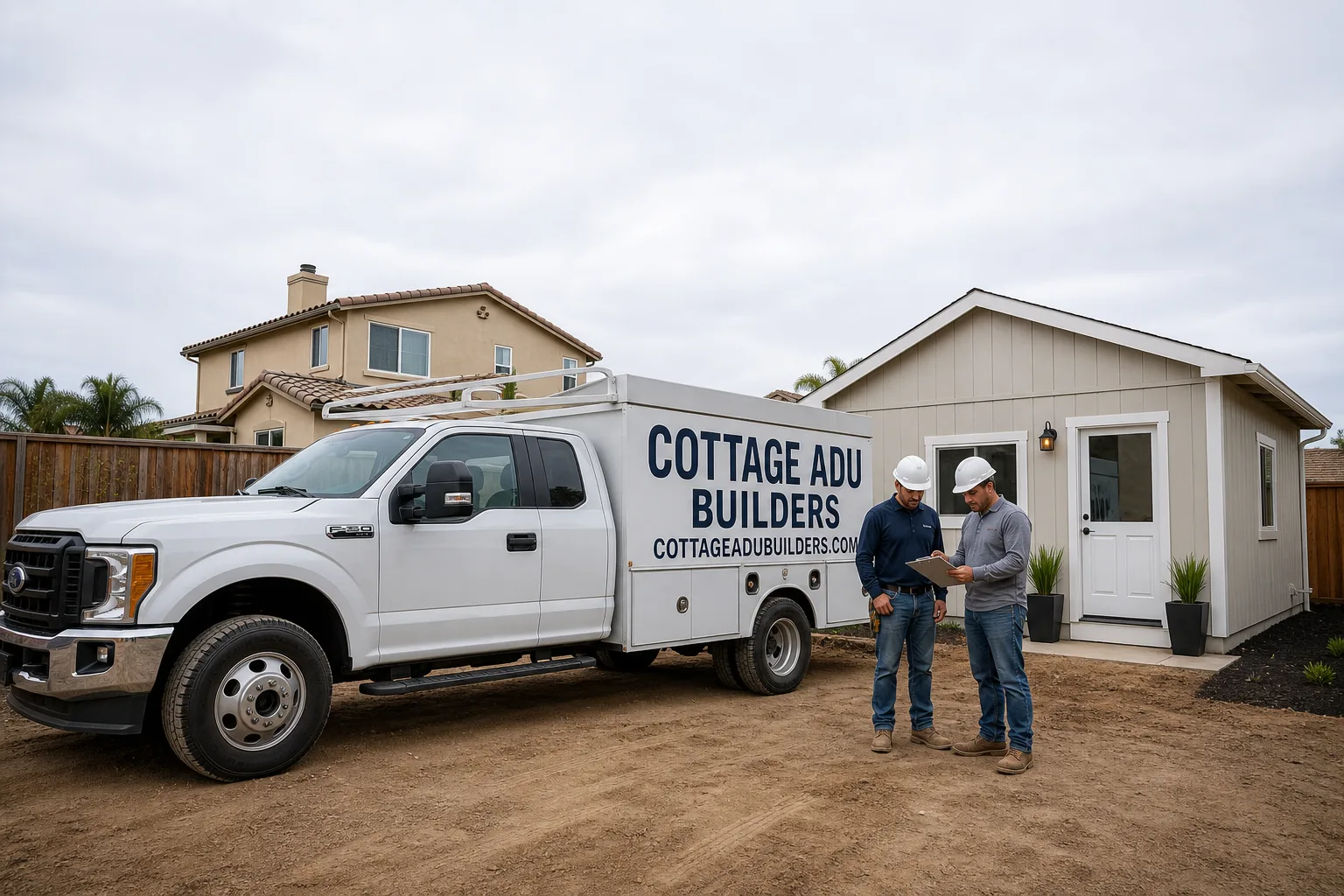
Fast, Reliable ADU Builders Across Fountain Valley
Adding an ADU to a Fountain Valley property usually means building a detached unit in the backyard of a 1960s or 1970s ranch home. That’s the reality of this city’s housing stock, and it shapes everything from foundation work to how we route utilities. We’ve built enough of these to know what’s behind the stucco before we open it up. If you’re weighing a backyard unit for rental income, a family member, or a workspace, call (866) 808-7312 and we’ll walk you through what your specific lot can actually support.
Fountain Valley’s lots are generous by Orange County standards, and many have rear alleys or wide side yards that make a detached ADU genuinely feasible. The catch is that the city’s own ordinance layers local setback and height rules on top of state law. We know those rules because we’ve worked inside them on streets from Slater Avenue to the neighborhoods around Mile Square Park.
Key takeaways for Fountain Valley homeowners:
- Most ADUs here are detached backyard units, not garage conversions or second-story additions.
- Fountain Valley caps detached ADU height at 16 feet and requires a 4-foot minimum rear setback.
- Older tract homes hide wiring and waterproofing issues that a permit will force you to address.
- We price the knowns up front and write allowances for what we can’t see until a wall is open.
Why Cottage ADU Builders Is Fountain Valley’s Preferred ADU Builders Company
Fountain Valley homeowners don’t need a generalist who splits time between commercial jobs and roofing. They need a contractor who understands that a 1960s ranch on a 6,000-square-foot lot behaves differently than a newer home in Huntington Beach or a tighter lot in Costa Mesa. That’s what we do. Our ADU Builders team works exclusively on residential square footage: ADUs, kitchens, and bathrooms. No commercial build-outs, no landscaping, no drift.
We work with the brands you’ve already been researching. Abodu, Plant Prefab, Tuff Shed, and James Hardie are systems we know from actual site work, not brochures. When a Fountain Valley lot has a block-wall fence sitting on the property line, that changes which prefab footprint works. When the marine layer rolls in off the coast every morning, that changes how we detail exterior cladding. Local knowledge isn’t a talking point here. It’s the difference between a clean build and a variance fight.
Neil Stratton leads our team with a straightforward approach: open the wall before you quote the finish. Too many Fountain Valley ADU quotes fall apart because the contractor priced from the tract-home floor plan and never looked at what’s inside the walls. We don’t do that.
ADU Plans in Fountain Valley
ADU Plans in Fountain Valley are where we earn or lose your trust. The city’s ADU ordinance caps a detached unit at 16 feet of height and demands a 4-foot rear setback, and many 1960s lots already have a block wall sitting on the property line. So the real design question is not “how big can I build?” but “what fits between the back of my house and that wall without triggering a lot-coverage variance?” We answer that question with a survey, a setback check, and a footprint that works before you spend a dime on construction drawings.
A typical set of ADU Plans for a Fountain Valley detached unit runs $4,500 to $9,500, depending on whether you’re working with a prefab manufacturer’s standard plans or a custom set drawn for an odd lot shape. Prefab systems like Abodu and Plant Prefab often reduce plan costs because the manufacturer supplies engineering, but Fountain Valley’s local ordinance still requires a site-specific review. Budget for it.
Site Review and Setback Math
We measure from the rear wall of the main house to the inside face of any existing block wall, then subtract the 4-foot setback. On a lot with a fence on the line, that subtraction often shrinks the buildable depth by more than homeowners expect. We’d rather tell you that on paper than after you’ve signed a contract.
Prefab vs. Custom Plan Paths
If you’re leaning toward a Tuff Shed or Plant Prefab unit, the plans come largely standardized, and our job is confirming the foundation, utility runs, and setbacks work on your Fountain Valley lot. Custom-built ADUs go the other direction: plans are drawn from scratch around an unusual yard shape or a specific interior layout. Both paths are viable here; the lot dictates which one saves you money.
ADU Contractor in Fountain Valley
An ADU Contractor in Fountain Valley has to manage what the city’s permit process triggers once walls are open. On a 1960s ranch, opening a rear wall to tie in utilities often exposes cloth-insulated wiring, unflashed stucco chases, and framing that hasn’t been visible since Eisenhower was in office. We handle that with written allowances in the contract, so when the panel needs an upgrade, you already know the price line and we already have your approval to proceed. No surprise change orders. No stopped work while everyone argues about cost.
General ADU construction for a detached backyard unit in Fountain Valley runs $180,000 to $350,000 for a turnkey 400 to 750-square-foot unit, including foundation, utilities, drywall, finishes, and permits. Prefab installations like Plant Prefab or Abodu trend toward the lower end of that range when the site prep is simple. Custom builds with upgraded kitchens and baths inside the ADU run higher.
Utility Tie-Ins and Panel Upgrades
Fountain Valley’s 1960s homes often have 100-amp panels that won’t carry an ADU’s electrical load. A panel upgrade to 200 amps typically runs $3,500 to $6,000, and we write that allowance into the contract before we open the wall. Sewer and water tie-ins depend on lot layout, but rear-alley lots usually make trenching simpler than side-yard-only access.
James Hardie Exteriors for the Marine Layer
Fountain Valley sits close enough to the coast that morning marine layer is a daily fact of life. We use James Hardie fiber-cement siding on applicable exteriors because it doesn’t swell, rot, or warp the way wood does in that damp-then-dry cycle. It costs more than vinyl up front, and it lasts longer than the alternatives. On an ADU that’s generating rent or housing family, exterior durability isn’t optional.
Trusted Brands We Service in Fountain Valley
We’re fluent in the prefab and modular systems Fountain Valley homeowners ask about by name: Abodu, Plant Prefab, Tuff Shed, and James Hardie for exterior cladding. That doesn’t mean we push one product. Your lot, your budget, the right system. We know factory timelines, site-prep requirements, and utility hookup sequencing for modular delivery because that’s the part general contractors get wrong. When a Plant Prefab unit arrives on a truck, the foundation, setbacks, and utility stubs have to be ready. We make sure they are.
Common ADU Builders Problems We See in Fountain Valley Homes
- Cloth-insulated wiring behind 1960s stucco. Fountain Valley’s tract homes were built when cloth-covered romex was standard. Once a wall is open for a utility tie-in, the city will require bringing exposed wiring to current code, and that’s a real line item, not a hypothetical. We write it in as an allowance from day one.
- Unflashed stucco chases above the slab. The rear walls of many Fountain Valley ranches have stucco that runs straight down to grade with no weep screed or flashing. Open that wall, add an ADU trench, and water intrusion becomes a problem you have to solve before rough-in. We detail the waterproofing on paper and in the contract.
- Block-wall fences sitting on the property line. Fountain Valley’s 4-foot rear setback is straightforward until you realize the existing fence is already on the line. The legal ADU footprint has to squeeze between the house and that wall, and on narrower lots that’s the difference between a 400-square-foot studio and a 300-square-foot one.
- Lot-coverage math that triggers variances. Between the footprint of a 1960s ranch, a detached garage, and a new ADU, some Fountain Valley lots push right up against the city’s lot-coverage limit. We check that number during the plan phase, not after you’ve paid for drawings.
Pricing for ADU Builders in Fountain Valley, CA
Detached ADUs in Fountain Valley run $180,000 to $350,000 for a finished 400 to 750-square-foot unit. A studio ADU at the small end lands around $160,000 to $220,000, while a two-bedroom custom build with a full kitchen and bath can reach $300,000 to $400,000. Junior ADUs inside the existing home footprint run lower, typically $90,000 to $150,000, because there’s no new foundation and fewer utility runs.
| ADU Type in Fountain Valley | Typical Price Range |
|---|---|
| Junior ADU (interior conversion) | $90,000 – $150,000 |
| Studio detached ADU | $160,000 – $220,000 |
| One-bedroom detached ADU | $180,000 – $280,000 |
| Two-bedroom custom ADU | $300,000 – $400,000 |
What moves the number: panel capacity, trench length, foundation type, and whether you’re using a prefab system or going fully custom. We give written line-item quotes so you can see exactly where the money goes. Call (866) 808-7312 to schedule a free estimate. We’ll walk the lot with you and tell you what’s realistic.
We Also Serve Cities Near Fountain Valley
Our team works throughout the Fountain Valley area and the surrounding Orange County cities. If you’re in Fountain Valley or just across the line in Midway City, Huntington Beach, Costa Mesa, or Westminster, we’re familiar with the local ordinances and lot patterns that shape ADU feasibility in each place. The same crew that builds your Fountain Valley unit can handle the kitchen or bath remodel in the main house, so you’re not coordinating two contractors.
Serving Fountain Valley, CA — Our Local Coverage Area
We’re based in the Fountain Valley area and know this community well. Use the map below to see our service coverage — if you’re nearby, we can almost certainly help.
FAQs About ADU Builders in Fountain Valley
A detached ADU in Fountain Valley must keep a minimum 4-foot rear setback from the property line. If your block-wall fence sits on the line, the ADU’s rear wall has to be at least 4 feet in front of it. That’s a hard city rule, not a suggestion. Call (866) 808-7312 and we’ll measure your specific lot before you commit to a floor plan.
Yes, in most cases. When we open a wall to tie in the ADU’s electrical or plumbing, the exposed wiring and framing must be brought to current code. On Fountain Valley’s 1960s tract homes, that usually means a panel upgrade or replacement of cloth-insulated wiring. We write those allowances into the contract up front so the cost is approved before work starts.
Yes. Fountain Valley’s housing stock is predominantly 1960s and 1970s single-story ranch homes on lots with rear alleys or wide side yards, which makes a detached backyard unit more practical than a garage conversion or second-story addition. Detached ADUs also avoid some of the structural complications of converting an attached garage. The trade-off is the 4-foot rear setback and the 16-foot height cap.
The most common issue is unflashed stucco that runs straight down to grade with no weep screed or drainage plane. We’ve opened rear walls on 1960s ranches near Slater Avenue and found stucco chases with no flashing above the slab. Once that wall is exposed for an ADU tie-in, the waterproofing has to be corrected to pass inspection. We detail that repair in the plan phase and price it in the allowance.
It does. Fountain Valley has its own ADU ordinance layered on top of state law, with a 16-foot height cap for detached units and a 4-foot minimum rear setback. Neighboring cities like Huntington Beach and Westminster have their own setback and height rules, and they’re not identical. That’s why a quote from a contractor who doesn’t work in Fountain Valley regularly can miss a setback conflict or lot-coverage issue before the permit is filed.
Get a straight answer about your lot. Call (866) 808-7312 to schedule a free estimate. We’ll look at your setbacks, your panel, and your block wall before you spend anything on plans.
Written by Neil Stratton, Owner at Cottage ADU Builders, serving Fountain Valley and Orange County with ADU construction, kitchen remodeling, and bathroom remodeling.